Why does custom furniture go wrong?
Most custom furniture fails before production begins. The recurring causes are site dimensions taken from a drawing instead of the finished room, approvals given by one family member rather than everyone who uses the piece, materials selected without accounting for daily care, and changes agreed verbally that nobody documented. A vendor who compresses pre-production to save two weeks has moved the risk onto you.
The failure is rarely in the workshop
A wardrobe arrives and misses the niche by 40mm. A sofa seat sits too high and the family stops using it within a month. Veneer lifts on a bar unit in the second monsoon.
In each case the workshop built exactly what the drawing specified. The drawing was wrong.
This is the part of the industry nobody discusses honestly, because the visible failure happens at installation and that is where the blame lands. The actual failure happened eight weeks earlier, in a meeting where the right question was not asked.
Five of those questions come up again and again.
1. The site was measured on paper, not on the floor
Floor plans are drawn before plaster, before flooring, before skirting. By the time furniture is built, the room is smaller than the plan. Sometimes by 15mm. Sometimes by 60.
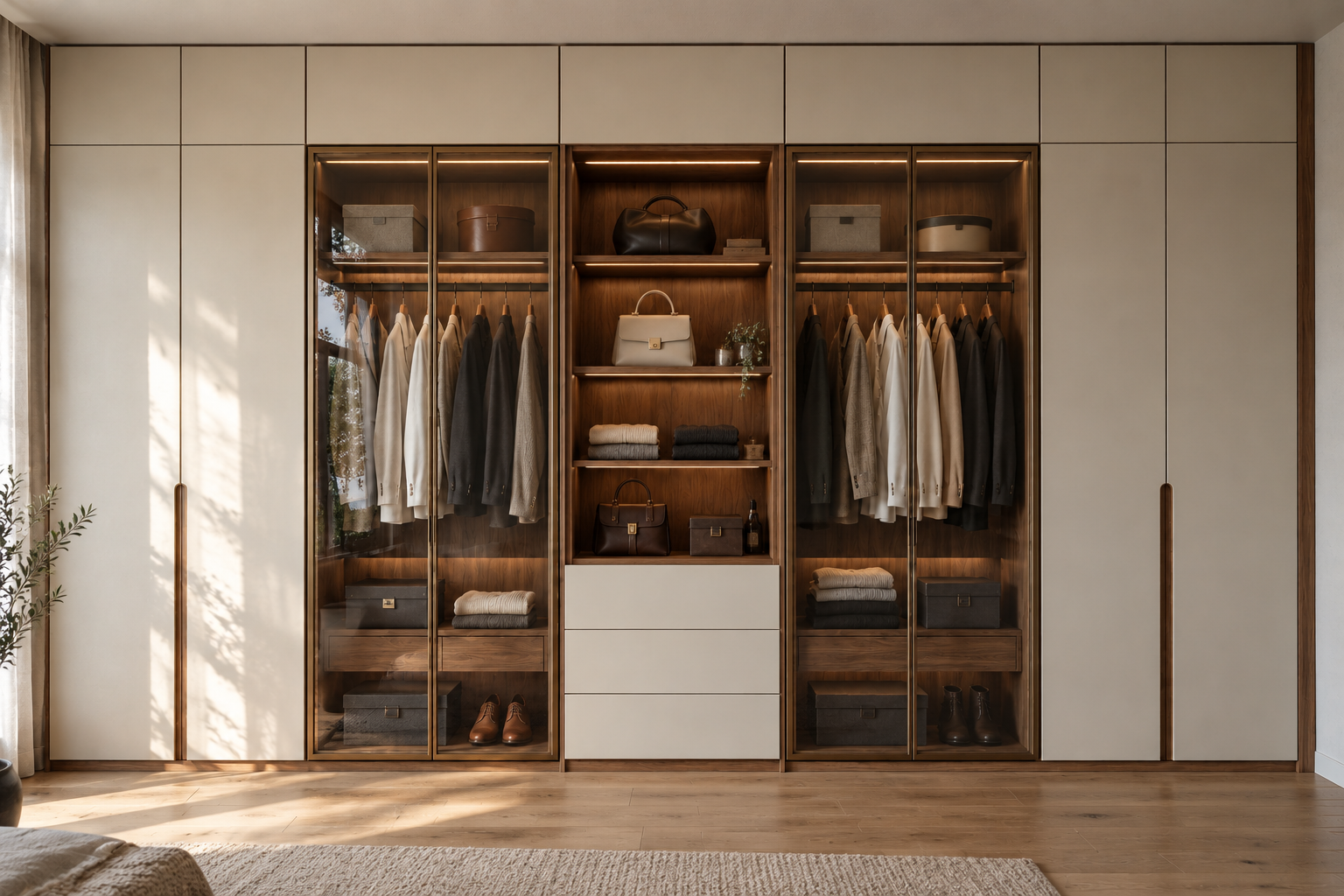
Loose furniture absorbs this. Fixed woodwork does not. A wardrobe either fits the niche or it does not, and there is no adjustment available at installation that does not look like a mistake.
The fix is physical validation — taping and marking real dimensions on the finished floor, after wet work is complete and before drawings are frozen. It takes half a day. Most vendors skip it because it costs a site visit and produces nothing the client can see.
2. One person approved. The family did not.
Wardrobe internals get approved by whoever attended the meeting. Three months later the person who actually uses it finds the hanging section too short for sarees, or no dedicated space for the things they own most of.
That is not a manufacturing defect. It is a briefing defect, and it surfaces at installation, when correction is most expensive.
Alignment has to happen across everyone who will use the piece, and it has to happen before drawings are signed. Not after.
3. Materials chosen for the render, not for the room
High-gloss lacquer in a home with young children. Open-pore oak next to a kitchen. Dark veneer in a room with no direct daylight.
Each of these is a legitimate material. None of them were matched to how the room is used or how much maintenance the household will realistically do.
This is the pillar most often skipped in a design meeting — care. It is an unglamorous conversation and it gets deferred, and then the finish that photographed well becomes the surface that shows every fingerprint for the next twelve years.
Ask what a material demands, not only what it looks like.
4. Ergonomics inherited from a catalogue
Seat height. Seat depth. Cushion density. Backrest angle.
A great deal of furniture sold in India is built to dimensions borrowed from European reference tables. Those tables assume a particular average height and a particular way of sitting. A family that sits cross-legged on a sofa needs a deeper seat than any catalogue default will give them. A dining chair that suits one household is wrong for the next.
If a vendor has not asked how you sit, they are building to a default and describing it as custom.
5. Nothing was written down
Verbal approval is the single largest source of dispute in this industry.
A change agreed in a site meeting, never documented, becomes an argument in month three — usually after advances have been paid and neither side can evidence what was said. Both parties are often being honest. They simply remember different conversations.
Shop drawings, signed. Every revision on paper. It is a dull discipline and it prevents most of what goes wrong.
What a compressed timeline actually costs
Custom furniture takes 8–14 weeks. A vendor promising six is not faster at manufacturing — machines run at the speed they run, and polish takes the time polish takes.
What has been compressed is pre-production. The stage with no visible output.
That is the trade being offered. Two weeks saved at the start, against the possibility of four weeks lost to rework at the end — or a piece that never fits properly and stays in the house for fifteen years anyway.
Five questions to ask before you sign
Will you physically validate site dimensions after finishes are complete, or work from the architect's drawing?
Who signs off on shop drawings, and what happens if a dimension turns out to be wrong?
What seat height and depth are you building to, and how did you arrive at those numbers?
Is the piece finished at your factory, or completed at site?
What does the warranty cover, and for how long?
The fourth question matters more than it sounds. If the answer is not "factory," expect carpenters working in your home for several weeks, with the dust and noise that involves.
How we handle it
At TIS Living, eight steps run before anything enters production: understanding how the family lives, documenting requirements against a checklist, aligning every family member on every decision, flagging the choices that cause problems later, working through detail, simplifying where a piece is over-designed, validating site dimensions physically, and compiling all of it into approved shop drawings.
Materials are selected from a library of 1,500+ options against the FACE framework — functionality, aesthetics, care, ergonomics. Everything is finished at our 40,000 sq ft Gurgaon factory on German machinery, and dispatched complete. No carpentry at site. Installation is handled by our own crew, in 50+ cities across 18+ states. Three-year manufacturing warranty, and service after that for as long as the piece exists.
None of this makes custom the right answer for everyone. If you need a dining table in three weeks, buy retail — a good retail piece delivered on time beats a custom one that arrives late. Custom earns its time when the space is unusual, when dimensions have to be exact, or when the piece has to last long enough that getting it wrong becomes expensive.
The eight weeks are not a delay. They are where the errors get removed.
Related reading
Share this story
Share

Written by
TIS Living
Stories, insights and design perspectives from the TIS Living editorial team.
Stay in the loop
More stories like this one
Design guides, material stories and project features — delivered when we have something worth saying.